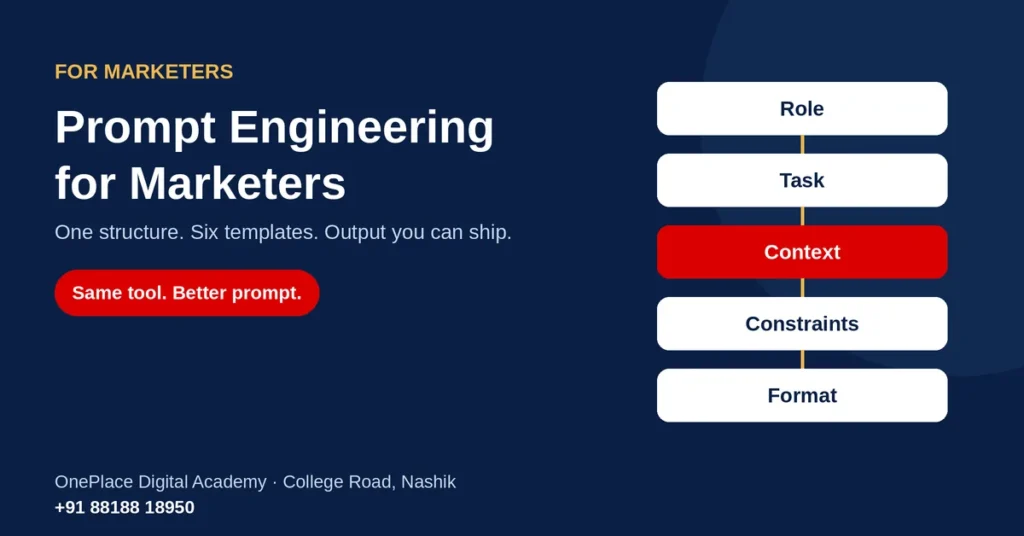
Prompt engineering for marketers means writing instructions so ChatGPT, Claude or Gemini gives you copy, plans and replies you can actually use, not generic filler you rewrite from scratch. It isn’t a list of magic phrases. It comes down to three habits: a five-part prompt structure, feeding the model real context, and testing a prompt before you trust it. Below you get the method, six templates for everyday marketing work and a ten-minute test you can run on any prompt.
It’s written for people like Rohit, 29. He’s the marketing executive at a real-estate developer on Gangapur Road, Nashik. He uses ChatGPT every day, but the ad copy keeps coming back the same: “luxurious living”, “dream home”, “unmatched amenities”. His manager rewrites half of it. Rohit doesn’t need more AI tools. He needs the tool he already has to understand his project, his buyer and his rules.
The short version
- Use five parts every time: role, task, context, constraints, format.
- Context beats clever wording. Paste the brief, the price band, the buyer and your brand rules. That’s where good output comes from.
- Ask for a format you can paste: a table, numbered variants, a character count.
- Split big jobs into steps. Research, then outline, then draft. Don’t ask for everything in one prompt.
- Test before you reuse. Run a prompt on three different inputs. If one fails, fix the prompt, not the output.
Why marketers get generic output
A language model predicts the most likely next words. Give it a thin request like “write ad copy for a 2BHK flat” and the most likely answer is the average of every flat ad it has seen. That’s why everything sounds like “luxurious living”. The fix isn’t a smarter tool. It’s a richer prompt. The more of your facts the model holds, the less it falls back on clichés.
| Thin prompt | What comes back | What was missing |
|---|---|---|
| “Write a Facebook ad for our 2BHK project.” | Generic praise, no price, no location, wrong length | Project facts, buyer, platform limits, format |
| “Make a content calendar for October.” | Festival posts any brand could use | Business goal, offers, audience, posting capacity |
| “Reply to this lead.” | A polite reply that doesn’t move the sale | Lead stage, next step you want, tone, your hours |
The 5-part prompt structure
| Part | What you tell the model | Example for Rohit |
|---|---|---|
| Role | Who it should act as | “You are a performance marketer for a Nashik real-estate developer.” |
| Task | One clear job | “Write 5 Meta ad headlines for our 2BHK launch.” |
| Context | Facts, audience, brand voice | Location (Gangapur Road), possession date, buyer (young families, first home), tone (plain, confident) |
| Constraints | Rules and limits | “Max 40 characters. No ‘luxury’ or ‘dream’. Mention RERA-registered.” |
| Format | How the answer must look | “Table: headline · angle · character count.” |
Role and task take ten seconds to write. Context is where you spend your effort. Keep a short “brand brief” document (offer, audience, tone, banned words) and paste it into every prompt. ChatGPT Projects, Claude Projects and Gemini Gems can also store it for you, so you don’t paste it every time.
Prompt engineering for marketers: six templates for everyday work
Copy these, replace the [brackets] and keep your brand brief at the bottom of each prompt. For a bigger library of ready prompts, see our 25 ChatGPT prompts for Indian marketers.
1. Meta or Google ad variants
Role: You are a performance marketer for [business type] in [city/area].
Task: Write 5 ad headline + primary text pairs for [offer].
Context: Audience is [who, age, need]. Key facts: [price band / USP / proof]. Tone: [tone].
Constraints: Headline max [40] characters. No [banned words]. Each pair uses a different angle (price, location, trust, urgency, lifestyle).
Format: Table with columns: angle, headline, primary text, character count.
2. Monthly content calendar
Role: You are a social media manager for [business] in [city].
Task: Plan [12] Instagram posts for [month].
Context: Goal this month is [enquiries / footfall / launch]. Offers: [list]. Local dates that matter: [festivals, events]. We can produce [2 reels + 1 carousel] per week.
Constraints: At least 4 posts must show real customers or staff. No generic festival greetings without an offer or story.
Format: Table: date, format, hook (first line), caption idea, CTA.
3. Lead reply that books the next step
Role: You are the sales coordinator at [business].
Task: Draft a WhatsApp reply to this enquiry: "[paste message]".
Context: The lead is at [stage]. The next step we want is [site visit / demo / call]. Our hours are [hours]. Tone: warm, short, no pressure.
Constraints: Under 60 words. One question at the end. No discounts unless asked.
Format: Two versions: one formal, one friendly.
4. Brand-voice rewrite
Role: You are our brand editor.
Task: Rewrite the text below in our brand voice.
Context: Brand voice rules: [paste 5–8 rules]. Two examples of copy we liked: [paste].
Constraints: Keep every fact. Cut length by 20%. Remove these words: [list].
Format: The rewrite, then a 3-bullet list of what you changed and why.
Text: [paste]
5. Monthly report summary for your manager
Role: You are a marketing analyst.
Task: Summarise this month's campaign numbers for a busy manager.
Context: [paste the table: spend, leads, cost per lead, site visits, bookings]. Last month: [paste].
Constraints: Only use numbers I gave you. If something can't be calculated, say so. No jargon.
Format: 3 wins, 2 problems, 2 actions for next month, each one line.
6. Blog outline before the draft (chaining)
Step 1 prompt: List the 8 questions a [persona] in [city] asks before [buying X]. Rank them by how often they come up.
Step 2 prompt: Using questions 1–5, create an H2/H3 outline for a 1,200-word post. One H2 per question.
Step 3 prompt: Write section [H2 #1] only, using these facts: [paste]. Max 200 words.
Template 6 shows prompt chaining: one big job split into small, checkable steps. It’s the habit that separates people who “use ChatGPT” from people whose AI output survives a client review. If you design graphics too, the same chaining works across tools. Our ChatGPT + Canva workflow walks through it.
Which model for which marketing job
| Job | Good first choice | Why |
|---|---|---|
| Long-form drafts, brand-voice rewrites | Claude | Follows tone rules and long briefs closely |
| Quick ad variants, brainstorming, images | ChatGPT | Fast, flexible, built-in image generation |
| Research with Google data, Docs/Sheets work | Gemini | Works inside Google Workspace |
Treat this as a starting point, not a rule. The same five-part prompt works in all three, so test your most-used template in each and keep whichever gives you the least editing.
The 10-minute prompt test
- Pick three real inputs: for example, three different leads or three different projects.
- Run the same prompt on each in a fresh chat.
- Score each output: correct facts? right length? on brand? usable without edits?
- When one fails, change the prompt, usually the context or a constraint, and re-run all three.
- Save the version that passes in a shared “prompt library” doc with a date and an example output.
Fix the prompt, not the output. Editing the output fixes one post. Fixing the prompt fixes every post after it.
Five mistakes that waste your time
- Trusting numbers the model “knows”. Never let it invent prices, stats or reviews. Give it the facts or tell it to leave a blank.
- One giant prompt. Five jobs in one message gets you five half-done jobs. Chain them.
- No banned-words list. If you hate “luxurious”, say so in the prompt.
- Pasting customer data carelessly. Remove phone numbers and personal details before you paste lead lists into any AI tool.
- Never saving what works. A prompt you can’t find next week is a prompt you’ll rewrite from memory, worse.
From prompts to automation
Once a prompt passes the test, you can stop running it by hand. Tools like n8n can take a new lead from your form, run your lead-reply prompt and drop the draft into WhatsApp or your CRM for a human to approve. Our n8n vs Zapier vs Make comparison explains which tool fits which team. If you’re starting from zero, how to learn prompt engineering lays out a learning path week by week.
Learning this properly in Nashik
You can learn a lot alone with the templates above. What a structured course adds is feedback: someone reviewing your prompts against real briefs, and a deadline to finish. At OnePlace on College Road, prompt engineering is taught inside the 4-month Advanced Certification in Digital Marketing (ACDM), alongside ads, SEO and social media, with AI built into every module and no coding needed.
Comparing online courses? Before you pay anyone, read our guide to live vs recorded online digital marketing courses in India, with 7 questions worth asking every institute.
Frequently asked questions
What is prompt engineering for marketers?
It is writing structured instructions so AI tools like ChatGPT, Claude and Gemini produce marketing work you can use with little editing: ad copy, content calendars, lead replies, reports. The core is a five-part structure (role, task, context, constraints, format) plus testing prompts on real inputs.
Do marketers need coding to learn prompt engineering?
No. Prompt engineering for marketing work is written in plain English. Coding only matters if you want to build AI apps. Connecting prompts to tools like n8n is visual and no-code.
Which AI tool is best for marketing prompts?
There’s no single winner. Claude is strong for long-form and brand-voice work, ChatGPT for quick variants and images, Gemini for research and Google Workspace. The same structured prompt works in all three, so test your key templates in each.
How do I stop ChatGPT from writing generic marketing copy?
Give it your real context: offer, product tier, audience, location, tone rules and a banned-words list. Ask for a specific format and character limits. Generic output almost always means the prompt was missing facts.
How long does it take to learn prompt engineering?
You can learn the basic structure in a weekend. Getting consistent, client-ready output takes a few weeks of practice on real tasks. A structured course with live review, such as ACDM at OnePlace in Nashik, helps you build a portfolio.
Is it safe to paste customer data into AI tools?
Remove personal details such as phone numbers, emails and addresses before pasting lead or customer lists. Follow your company’s data policy, and use business or team plans where your employer provides them.
Want feedback on your prompts from a trainer? Book a free demo class at OnePlace Digital Academy, Soham Complex, Patil Lane No. 3, College Road (above Namco Bank), Nashik. Bring one marketing task you do every week, and we’ll turn it into a tested prompt with you.
Or call +91 88188 18950. Rated 5.0 on Google.