You have a full-time job. You already use ChatGPT or Gemini most days. And you have quietly noticed that the output needs so much rewriting that you sometimes wonder whether it saved you any time at all. That gap is what prompt engineering closes — and you do not need to quit your job or learn to code to close it.
This is a six-week plan built for people with roughly five hours a week to spare. It is honest about what has stopped working in 2026, and it prioritises the parts of the skill that still transfer as models keep improving.
What prompt engineering actually means in 2026
Prompt engineering is designing the input to an AI model so the output is accurate, consistent and usable without heavy editing. Three years ago that meant collecting clever phrasings — “act as an expert”, “take a deep breath”, and the rest. Most of that is now obsolete. Models handle vague instructions far better than they did, and the magic-phrase era is over.
What replaced it is less glamorous and considerably more useful: supplying the right context, constraining the output format, breaking large jobs into steps, and testing your prompts against real cases instead of trusting the first good result. Those four things are what this plan teaches, and they are the parts that will still matter when the next model ships.
The simplest test of whether you have learned prompt engineering: can you hand your prompt to a colleague and have it produce the same quality of output for them? If it only works when you personally babysit it, you have not finished.
The 6-week plan
Roughly five hours a week — two short weekday sessions and one longer weekend block. Each week produces something you keep.
| Week | What to learn | What to produce |
|---|---|---|
| 1 | How models behave — context windows, why they hallucinate, where ChatGPT, Claude and Gemini each perform best | A one-page note on which model you will use for which task |
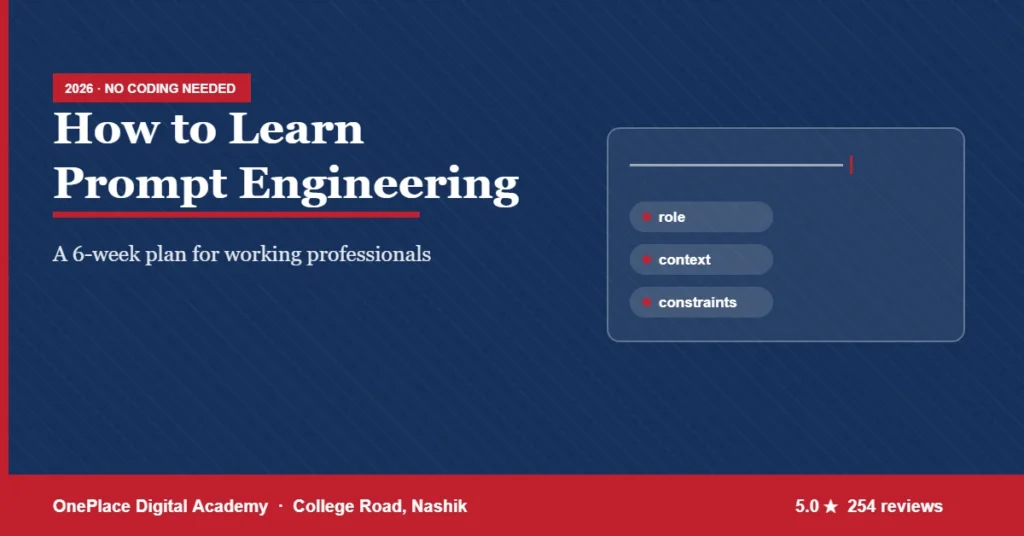
| 2 | Prompt anatomy — role, task, context, constraints, output format. Few-shot examples. | Five reusable prompts for tasks you actually repeat at work |
| 3 | Context engineering — feeding documents, brand guidelines and data instead of hoping the model already knows | A prompt that produces on-brand writing from a style guide you paste in |
| 4 | Structured output — tables, JSON, fixed schemas. Prompt chaining for multi-step jobs. | A two-step chain that turns a rough brief into a finished deliverable |
| 5 | Evaluation — testing a prompt against ten real inputs, spotting failure patterns, versioning | A tested prompt with documented pass and fail examples |
| 6 | Automation — connecting a prompt to your tools so it runs without you | One workflow that runs on a schedule or a trigger |
Week 1–2: stop guessing, start structuring
Most people’s prompts fail for a boring reason: they contain contradictory instructions, or they never specify the format. Compare these two.
- Weak: “Write some Instagram captions for my shop.”
- Structured: “You are writing for a family-run furniture showroom on Gangapur Road, Nashik. Audience: married couples aged 28–45 furnishing a first home. Write 5 Instagram captions, each under 125 characters, each ending with a question. Tone: warm, no exclamation marks. Return as a numbered list.”
The second version names the role, the audience, the count, the length limit, the tone, a constraint and the output format. Nothing clever is happening — it is just complete. Spend two weeks making every prompt that complete and your output quality will jump before you learn a single advanced technique.
Week 3: context beats phrasing
This is the shift most self-taught learners miss. In 2026, what you put around the instruction matters more than the instruction itself. Paste in the actual brand guidelines. Paste in three examples of past work you liked. Paste in the real data rather than describing it. A mediocre prompt with excellent context beats an elegant prompt with none, almost every time.
Week 4–5: formats and testing
Ask for a table and you can paste it straight into a sheet. Ask for JSON and you can feed it to another tool. Ask for “some ideas” and you get prose you have to reformat by hand. Specify the shape you want.
Then test properly. Run your prompt against ten real inputs, not one. You will find it works beautifully on the easy cases and collapses on the awkward ones — the client with a strange product name, the input with missing fields. Fixing those edge cases is what turns a prompt into something you can rely on.
Week 6: make it run without you
A prompt you have to open a browser to run saves you minutes. A prompt wired into a workflow saves you hours. Tools like n8n and Make connect your tested prompt to email, sheets and forms with no code. If that appeals, our walkthrough on building an AI marketing agent step by step picks up exactly here.
Free resources versus a classroom — an honest comparison
Plenty of good free material exists. It is worth being clear about what each route does and does not give you.
| Self-taught (free) | Structured course | |
|---|---|---|
| Cost | Nothing | Paid |
| Pace | Yours — which often means it stalls | Fixed, with deadlines |
| Feedback | None. You cannot see why your prompt failed. | Someone reviews your actual work |
| Portfolio | Only if you are disciplined about it | Built in as coursework |
| Best for | Testing whether you enjoy this at all | Getting to a demonstrable skill on a deadline |
Start free. If you are still going after three weeks, the bottleneck stops being information and starts being feedback — nobody is telling you why the model ignored your third instruction. That is the point at which a classroom earns its cost. The same logic applies to marketing skills generally, which we covered in how to learn digital marketing while working full time.
Where this skill pays off in a marketing job
Prompt engineering on its own is a supporting skill, not usually a job title. It pays when attached to something else — ad copy production, SEO briefs, reporting, customer support flows. Two areas where it compounds fastest right now:
- Content operations — producing genuinely on-brand drafts at volume, which is a context-engineering problem more than a writing one.
- Getting cited by AI search — structuring content so ChatGPT and Perplexity quote your brand. We explain that shift in our GEO vs SEO vs AEO guide.
If you are aiming at a marketing role rather than the AI skill in isolation, prompt engineering sits inside a broader stack — SEO, paid ads, analytics, automation. That is what our Advanced Certification in Digital Marketing (ACDM) covers over four months at our College Road campus in Nashik.
A note for readers in Nashik
If you would rather learn this with someone checking your work, we run prompt engineering as hands-on training at our College Road campus — Soham Complex, Patil Lane 3, above Namco Bank — with weekday-evening and weekend batches for people who are working. Bring a prompt that is not behaving and we will rebuild it with you in the demo session. That will tell you more than any brochure.
Frequently asked questions
How long does it take to learn prompt engineering?
With around five hours a week, six weeks is enough to reach a working standard — writing structured prompts, supplying context properly, controlling output format, and testing your results. Reaching a level where you can build and maintain automated workflows takes a few months of regular use beyond that.
Do I need coding skills to learn prompt engineering?
No. Prompt engineering is a writing and reasoning skill rather than a programming one. Even the automation stage can be done with visual no-code tools such as n8n and Make. If you can write a clear brief for a colleague, you can learn this.
Is prompt engineering still worth learning in 2026?
Yes, but the skill has changed. Lists of clever phrasings have largely stopped mattering because models now handle vague instructions well. What still matters — and is growing in value — is context engineering, structured output, prompt chaining and systematic testing. Learn those rather than memorising phrases.
What is the difference between prompt engineering and context engineering?
Prompt engineering is how you phrase the instruction. Context engineering is what information you place alongside it — documents, brand guidelines, examples, real data. In practice the second now has more impact on output quality than the first.
Which AI model should I practise with?
Practise with more than one. ChatGPT, Claude and Gemini have different strengths, and the technique transfers between them. Committing to a single model is risky because rankings change every few months; the underlying discipline does not.
Can I learn prompt engineering in Nashik in a classroom?
Yes. OnePlace Digital Academy runs hands-on prompt engineering training at its College Road campus in Nashik, with weekday-evening and weekend batches suited to working professionals, plus a live-online option. Call or WhatsApp +91 88188 18950 for current batch dates.
Want someone to look at your actual prompts?
Book a free demo at OnePlace Digital Academy, College Road, Nashik — bring a prompt that is not working and we will fix it with you.
WhatsApp +91 88188 18950 →
Learning Prompt Engineering in Nashik — At a Glance
Where prompt engineering actually sits in 2026: not a standalone career, but a skill that multiplies whatever you already do.
| Honest positioning | Prompt engineering is no longer a standalone job title. It is a core skill inside marketing, automation and agent-building roles — and that is how it is taught here |
|---|---|
| Where to learn it in Nashik | Built into every AI program at OnePlace Digital Academy, College Road — not sold as a separate certificate |
| Inside the ACDM program | Prompting for ad copy, landing pages, SEO briefs, email sequences and creative direction — applied to live client campaigns |
| Inside the Agentic AI track | System prompts, prompt chaining, tool-use prompts and multi-agent role prompts across LangChain and CrewAI (7 weeks) |
| Models covered | ChatGPT, Claude, Google Gemini — including how the same prompt behaves differently across them |
| Techniques taught | Role and context framing · few-shot examples · structured output (JSON, tables) · chain-of-thought and step decomposition · guardrails and refusal handling · evaluating and iterating a prompt instead of guessing |
| Beyond text | Image prompting in Midjourney and Canva AI; video and voice prompting in HeyGen and ElevenLabs |
| What you produce | A reusable prompt library for your own role or business — the actual deliverable, rather than a certificate |
| Free alternatives | Genuinely useful: SWAYAM, Google and OpenAI have low-cost or free prompt courses. Do those for theory. Come to a classroom for the applied campaign work and feedback, which is what the free courses cannot give you |
| Mode & batch | Offline classroom on College Road, batches of 15, weekday / evening / weekend slots |
| Contact | +91 88188 18950 · Mon–Sat, 9 AM – 7 PM |
Is there a prompt engineering course in Nashik?
Is prompt engineering still a good career in 2026?
Should I just do a free online prompt engineering course?
What prompt engineering techniques will I actually learn?
Do I need coding to learn prompt engineering?
Which AI models does the course cover?
Want prompting taught on your own work, not a sandbox? Book a free demo class on College Road and bring a real task — we will build the prompt with you.
Book a Free DemoRelated at OnePlace: AI classes in Nashik · AI Agent Building course · ACDM — AI digital marketing · n8n Automation course · GEO & AEO course