A digital marketing portfolio for freshers is not a resume with better fonts. It is three to five pieces of finished work that show you can run a campaign, not just describe one. You do not need paying clients to build it — you need a real business as the subject, a real problem, and evidence of what you did: the brief, the work, the numbers you tracked, and what you would change next time. This guide gives you the five projects worth building, where to host them, how AI shortens the work without flattening it, and a 30-day schedule that fits around a job.
Written for the person who has finished a BCom, BA, BSc or BBA, decided marketing is the direction, and now has to prove it to someone who has never met them. If you are still at the earlier stage of that decision, start with our 90-day career change plan for graduates and come back here.
What a hiring manager actually opens
Sit in on shortlisting at a Nashik agency and the pattern is uncomfortable. A team lead opens your link on a phone, between two client calls, and gives it about ninety seconds. They are not reading. They are scanning for three answers:
- Has this person touched the tools? A screenshot of Ads Manager, Search Console or GA4 settles in two seconds what a paragraph cannot.
- Can they write? Ad copy, a subject line, a caption. Marketing is a writing job wearing a technology costume.
- Can they explain a decision? Why that audience, why that budget split, why they killed the second creative on day four.
A portfolio’s job is not to prove you know the tools. It is to prove someone can hand you a task on Monday and not have to check on you until Thursday.
Everything below is built to answer those three questions in the order a busy person asks them.
The five projects that get freshers hired
You do not need ten projects. Five well-documented ones cover every skill an entry-level brief will throw at you, and the whole set is buildable in a month of evenings.
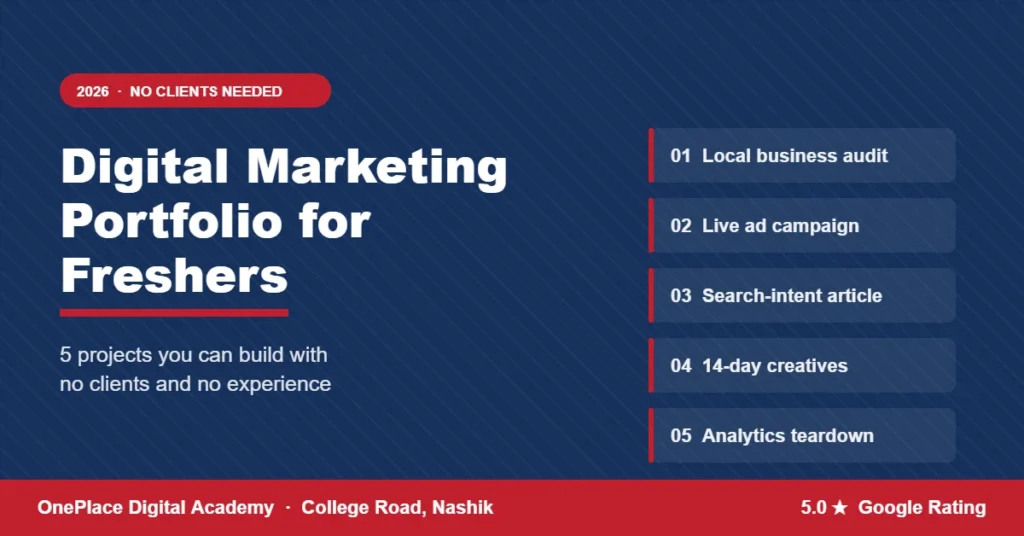
| # | Project | What it proves | Your time |
|---|---|---|---|
| 1 | Local business audit | You diagnose before you sell | 6–8 hours |
| 2 | A small live ad campaign | You have used Ads Manager for real | 10 hours + 7 days running |
| 3 | One search-intent article | You write for search and track it | 8 hours + 6 weeks waiting |
| 4 | 14-day content calendar with creatives | You can produce at volume, on brand | 8 hours |
| 5 | Analytics teardown | You read data instead of guessing | 4–5 hours |
Project 1 — Audit one real local business
Pick a business you can actually observe: a salon on Gangapur Road, a cafe near College Road, a sweet shop in Panchavati, your uncle’s hardware store. Then work through a fixed checklist so the output looks like a professional deliverable and not an opinion.
- Google Business Profile — categories, photos, hours, are reviews being replied to at all?
- Website — does it load in under three seconds on 4G, is there a phone number above the fold, does the WhatsApp button work?
- Meta Ad Library — are they running ads? Are their two nearest competitors? This is public and takes four minutes.
- Social cadence — posting frequency, what gets saves and shares, what gets ignored.
- The one-page fix list — three problems, ranked by what you would do first and why.
Deliverable: a six-slide PDF. Findings, evidence screenshot, recommendation, expected effect. That last column is what separates an audit from a complaint. And if the fix list is genuinely useful, send it to the owner — that is how a surprising number of freshers land their first real project.
Project 2 — Run one small campaign with your own money
This is the project that moves you out of the “read about it” pile. Spend a small amount you can afford to lose — a thousand rupees is enough — on a campaign you have the right to run. Use your own page, your own portfolio site, or a family or friend’s business with their written permission and their ad account. Never run ads on a business’s assets without asking.
Build it in Ads Manager, not the Boost button, so you actually learn objectives, audiences and placements. Our step-by-step Meta ads playbook for Nashik retail shops walks the exact structure — follow it and document as you go.
What to capture: the campaign structure screenshot, both creatives, the results table after seven days, and a short honest note on what you would change. Under-performing results documented well beat imaginary results every time. Interviewers can tell the difference immediately.
Project 3 — Publish one article and track it
Pick a long-tail question a real person types, something narrow enough to have a chance — “how much does a pre-wedding shoot cost in Nashik” rather than “photography tips”. Write the honest answer in the first hundred words, then support it. Publish it somewhere you control, connect Search Console, and leave it alone for six weeks.
Then screenshot the impressions and average position. Even a page sitting at position 30 proves something a certificate cannot: you shipped, you measured, and you understand that search takes time. Start this project first — the six-week wait runs in the background while you build the rest.
Project 4 — A 14-day calendar with the creatives actually made
Most fresher portfolios contain a content calendar in a spreadsheet and nothing else. Empty calendars are cheap. Pick a local brand, plan fourteen days with a stated objective per post, and then design all fourteen in Canva to a consistent template. Include three caption variants for two of them so a reviewer can see you think in tests, not in single guesses.
This is the project a reviewer skims fastest and judges hardest, because output quality is visible in one screen. Keep the template disciplined: two fonts, three colours, one logo position.
Project 5 — Read a real analytics account
No traffic of your own yet? Google publishes a free public GA4 demo account with live e-commerce data. Anyone can open it. Pull one month, then answer four questions in a one-page memo: which channel brought the most revenue, which brought the most sessions, where those two disagree, and what you would spend more on next month.
Being the fresher who can say “sessions and revenue disagree here, and here is why” puts you ahead of most people in the room, including some with two years of experience.
Where to host it so the link actually gets opened
The best format is the one that opens instantly on a phone, without a download and without a permission request.
| Format | Best for | Effort | Watch out for |
|---|---|---|---|
| Notion page | Everyone, as the main link | Low | Set sharing to public or it dies at the first click |
| One-page site | Anyone applying for web or SEO roles | Medium | Worth it — the site itself becomes evidence |
| PDF deck | Email and WhatsApp attachments | Low | Keep it under 10 MB or it never gets forwarded |
| Google Drive folder | Backup only | Lowest | Loose files signal loose thinking; access requests kill it |
Practical setup: one public Notion page as the primary link, one PDF export as the attachment. Name the file Firstname-Lastname-Digital-Marketing-Portfolio-2026.pdf, not portfolio final v3 latest.pdf. Then put that link in your LinkedIn featured section — our LinkedIn profile optimization guide for marketing jobs covers how recruiters search before they ever click.
Where AI saves you a week — and where it costs you the offer
Used properly, AI compresses a month of portfolio work into three weekends. Used lazily, it produces five projects that read like one person wrote them in one sitting, which is exactly what a reviewer suspects.
| Hand this to AI | Keep this yourself |
|---|---|
| Restructuring your audit notes into slide order | The three problems you chose and their ranking |
| Twenty hook variations to pick from | The two you shortlisted and why |
| A first draft of the GA4 summary paragraph | The actual reading of the numbers |
| Tightening captions to fit a character limit | The brand voice decision underneath them |
| Spotting gaps in your article outline | The real example that makes it yours |
One test protects you: for every line in your portfolio, you must be able to explain the decision behind it in thirty seconds without notes. If you cannot, it is not your work yet — either understand it or cut it. Sharper prompting makes the drafts far more usable; our guide on how to learn prompt engineering is the fastest way to stop getting generic output.
The 30-day build schedule
Roughly ten hours a week, built to sit around a job or final-semester classes. The order is deliberate: the slow-burning projects start first.
| Week | Build | Runs in background |
|---|---|---|
| Week 1 | Write and publish the article (Project 3); connect Search Console | Article starts ageing |
| Week 2 | Audit the local business (Project 1); launch the ad campaign (Project 2) | Ads run 7 days |
| Week 3 | Pull ad results; build the 14-day calendar and all creatives (Project 4) | — |
| Week 4 | Analytics teardown (Project 5); assemble Notion page, export PDF, update LinkedIn | Search Console data accumulating |
Revisit the article’s Search Console numbers at week six and add the screenshot. A portfolio that gets updated is worth more than one that gets finished.
Five things that get a fresher portfolio rejected
- Course assignments presented as client work. Label practice as practice. Reviewers recognise the standard course brief instantly, and the dishonesty costs more than the project earns.
- Certificates in place of work. Certificates prove attendance. Work proves capability. Put certificates at the bottom, small.
- Screenshots with no context. Every image needs one line above it saying what it is and what it shows.
- Numbers with no source. If you cannot show where a figure came from, delete it. One unverifiable claim makes a reviewer doubt the rest of the page.
- A link that asks for access. Test your own link in an incognito window before you send it anywhere. This single failure ends more applications than weak work does.
Building it with guidance instead of alone
Every project above can be done solo, and plenty of people have done exactly that. What is hard to get alone is correction — knowing whether your audit missed the obvious thing, whether your ad structure would embarrass you in an interview, whether your creatives look current.
That is the part we build into training at our College Road campus in Soham Complex, Nashik: live campaigns with real budgets, work reviewed by people who run accounts, and a portfolio you leave with rather than one you promise to make later. Both the Advanced Certification in Digital Marketing and our longer PG diploma are built around shipped work, not slide decks. If you are weighing options locally, our honest comparison of Nashik institutes lays out the differences without the sales pitch.
Frequently asked questions
Do I need a paying client to build a digital marketing portfolio?
No. Every project in this guide uses a real business as the subject without requiring payment or a formal engagement — a local shop you can observe, a family business that gives you written permission, or a public demo analytics account. What matters to a reviewer is that the problem and the data were real, not that money changed hands.
How many projects should a fresher portfolio have?
Three at minimum, five ideally. Beyond five you are adding volume, not evidence. One audit, one live campaign, one written piece with search data, one set of creatives and one analytics read covers every skill an entry-level brief will ask for.
My campaign performed badly. Should I still include it?
Yes, if you document it honestly. A campaign with weak results plus a clear explanation of what you would change is more convincing than a flawless-looking case study nobody can verify. Interviewers ask follow-up questions, and honest work survives them.
Can I use AI to build my portfolio?
Use it for drafts, variations and restructuring — not for decisions. The rule that keeps you safe is simple: you must be able to explain any line in your portfolio in thirty seconds without notes. If you cannot, either learn it properly or remove it.
How long does it take to build a portfolio from scratch?
About 30 days at ten hours a week for the build itself, with one project (the search-intent article) needing another few weeks of data before you screenshot it. Start the article in week one so the waiting happens in the background.
Where should I host my portfolio if I am job-hunting in Nashik?
A public Notion page as your main link, plus a PDF export for WhatsApp and email — most Nashik agency owners will open it on a phone. Test the link in an incognito window first; a page that asks for access is the most common reason a fresher portfolio never gets seen.
Want your portfolio reviewed before you send it?
Book a free 1-on-1 demo at our College Road campus in Nashik. Bring whatever you have built so far — we will tell you what an agency reviewer would say about it, and what to fix first. No cost, no obligation.
OnePlace Digital Academy · Soham Complex, Patil Lane No. 3, College Road, Nashik 422005 · Rated 5.0 on Google