A gap year after 12th is not a wasted year if you plan it. Colleges and employers rarely ask whether you took a gap; they ask what you did with it. The students who come out ahead pick one main goal (an entrance exam retake, a skill, or work experience), add one practical skill on the side, and finish the year with proof: a score, a certificate, a portfolio or a reference. This guide gives you a month-by-month plan, the AI and digital skills worth learning, and a simple way to explain the year in any interview.
It’s written for students like Priya, 17. She finished 12th Science at a junior college near Gangapur Road, Nashik. Her NEET result wasn’t what she hoped for. Her parents are split: one says repeat, one says take BSc admission now. Her friends have already moved to Pune. She’s worried that one year off will follow her forever. It won’t, if the year has a plan.
The short version
- A gap year is common. Students take one to retake NEET, JEE or MHT-CET, to recover from a tough 12th, to earn, or to decide what they want. None of these is a red flag on its own.
- The risk is drift, not the gap. An unplanned year with no output is what hurts. A planned year with proof is an asset.
- One main goal + one side skill. If you’re retaking an exam, keep that first and give a skill 4 to 5 hours a week. If you’re not, make the skill your main goal.
- AI and digital skills fit a gap year well. They are short to learn, you can start free, and you can show real work within weeks.
- End the year with evidence. A portfolio, a certificate, an internship letter or an exam score answers every question about the gap.
Is a gap year after 12th a bad idea?
Not by itself. What matters is the reason and the plan. Use this table to check where you stand.
| Situation | Gap year makes sense? | What to watch |
|---|---|---|
| Retaking NEET, JEE or MHT-CET with a clear score target | Yes | Set a deadline. Keep a backup skill so the year counts either way |
| Didn’t get the college or course you wanted | Often | Compare a gap year with taking admission now and adding a skill alongside your degree |
| Need to earn or support family for a while | Yes | Pick work that teaches you something you can show later |
| Unsure what to study next | Sometimes | Give yourself 3 months to test 2 or 3 fields, then decide. Don’t let “deciding” take 12 months |
| Just want a break with no plan | Risky | A short rest is fine. A full year with nothing to show is hard to explain |
If you’re torn between a gap year and starting college now, read our guide on taking a digital marketing course along with your degree. For many students that is the safer path.
4 ways to use a gap year, compared
| Gap-year plan | Main goal | Side skill | Best for | Proof at the end |
|---|---|---|---|---|
| Exam retake + skill | Better NEET / JEE / CET score | 4 to 5 hrs a week of digital or AI skills | Students with a clear exam target | Scorecard plus a small portfolio |
| Skill-first year | Job-ready skill such as digital marketing with AI | Spoken English or a second skill | Students ready to move away from the exam route | Certificate, live projects, internship |
| Work + learn | Earn and get real experience | An online or weekend course | Students who need income now | Experience letter and work samples |
| Distance degree + skill | Degree progress from home | Practical skill alongside | Students who want the degree clock running | Year-1 marks plus a skill certificate |
Nashik students can also look at distance learning through YCMOU (Yashwantrao Chavan Maharashtra Open University), which is headquartered in Nashik. Check admission timelines and recognition for your target course directly with the university before you decide.
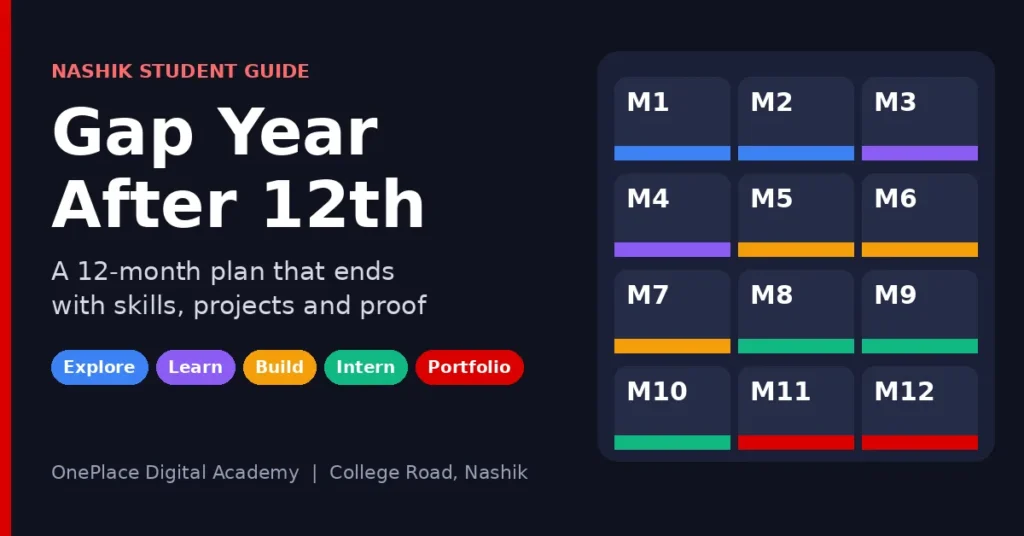
A 12-month gap year plan
This plan assumes the skill-first route. If you’re retaking an exam, keep the same order but run it at 4 to 5 hours a week, mostly on weekends.
| Months | Focus | Output by the end |
|---|---|---|
| 1 to 2 | Rest, reset and explore. Try free lessons in 2 or 3 fields: digital marketing, design, coding with AI | A clear choice of one skill |
| 3 to 4 | Learn the basics properly with a structured course or a strict self-study plan | Notes, first practice projects, a certificate or two |
| 5 to 7 | Real projects. Help a local shop, a relative’s business or a college club with social media, a website or Google Business Profile | 2 to 3 projects with before-and-after results |
| 8 to 10 | Internship or freelance work | Internship letter or paid work samples |
| 11 to 12 | Package it. Portfolio, LinkedIn profile, college applications or job applications | A portfolio link and a 60-second story about your year |
Start building your portfolio from Month 3, not Month 11. Our portfolio guide for freshers shows what to include.
If you’re retaking NEET or JEE
Your exam comes first. A side skill should never eat into prep time. Here is a balance that works for most repeaters:
- Weekdays: exam prep only. No new skill on test-series days.
- Weekends: 2 to 3 hours of one skill, such as Canva, basic social media marketing or AI tools.
- After the exam: 2 to 3 months before results and admissions are the best time to go full-time on the skill.
- Why bother: if the score comes through, you start college with a skill your classmates don’t have. If it doesn’t, you already have a Plan B with real work to show.
Skills worth learning in a gap year
Pick skills where you can start free, see progress in weeks and show proof. These fit that test:
| Skill | Why it’s worth it | Free way to start | Time to basic level |
|---|---|---|---|
| Social media marketing | Every local business in Nashik needs it, from College Road cafes to coaching classes | Run a page for a family business or club | 4 to 6 weeks |
| SEO and Google Business Profile | Brings in customers from Google search and Maps | Optimise a relative’s shop profile | 4 to 6 weeks |
| AI tools for marketing | ChatGPT, Gemini, Claude and Canva AI cut content work from hours to minutes | Use them on real tasks, not just prompts for fun | 2 to 4 weeks |
| Google Ads and Meta Ads | Paid ads are where businesses spend; people who can run them are useful | Free Google Skillshop lessons | 6 to 8 weeks with practice |
| Website building with AI | Small businesses need simple sites and landing pages | WordPress or an AI builder on a free plan | 4 to 6 weeks |
Our list of free AI tools for students is a good place to begin, and the digital marketing scope after 12th guide explains where these skills lead.
How to explain your gap year
Keep it short, honest and about what you did. Use this three-part answer in college interviews, job interviews and on your CV:
- Why: “I took a year to retake NEET” or “I took a year to build a practical skill before college.”
- What: “I completed a digital marketing course and ran social media for two local businesses.”
- Result: “One shop’s Google profile now gets more calls, and I’ve added the work to my portfolio.”
Never hide the year or apologise for it. A clear story with proof is stronger than a smooth CV with nothing on it.
Mistakes that waste a gap year
- Waiting for results or admissions before starting anything.
- Joining three courses at once and finishing none.
- Learning only from videos without doing real projects.
- Choosing an institute on promises instead of student work you can see.
- Cutting off from friends and family. A weekly check-in with someone keeps you on track.
Questions to ask before you join any course
- Will I work on real projects, or only watch lessons? Ask to see recent student work.
- Are AI tools taught as part of the course? Ask which ones and how they’re used in actual campaigns.
- Are there weekday and weekend batches? This matters if you’re also preparing for an exam.
- What does internship or placement assistance include? Ask for names and outcomes you can verify. Ignore promises with no proof.
- Can I attend a free demo class first? A good institute won’t mind.
On earnings, don’t trust any figure from a sales pitch. Read our digital marketing salary guide for Nashik so you know what questions to ask.
Where OnePlace fits
We’re an AI-integrated digital marketing institute at Soham Complex, College Road, Nashik. Two programmes suit a gap year:
| Programme | What it covers | Good fit if |
|---|---|---|
| Advanced Certification in Digital Marketing | A 4-month programme with 56+ modules: SEO, social media, Google Ads, Meta Ads, websites and AI tools, with live projects | You want a job-ready skill and real work to show by the end of the year |
| AI courses | Shorter AI programmes such as Vibe Coding, n8n automation and GEO/AEO | You want to add one focused AI skill alongside exam prep or a degree |
Weekday and weekend batches are available. If you’re weighing AI-specific options, our guide to an AI course after 12th in Nashik compares them, and you can turn your course projects into experience through a digital marketing internship in Nashik.
Frequently asked questions
Is a gap year after 12th bad for my career?
No, not if you plan it. Colleges and employers care about what you did with the year. A retake score, a certificate, live projects or an internship letter turns the gap into a strength.
Can I take a gap year after 12th and still get into a good college?
Yes. Most entrance exams and degree admissions accept students who took a year off. Check the eligibility rules for your target exam and college, and keep a record of what you did during the year.
What should I do in a gap year after 12th?
Pick one main goal, such as an exam retake, a job-ready skill or work experience, and add one side skill. Digital marketing and AI tools fit well because you can start free and build real projects within weeks.
How do I explain a gap year in an interview?
Use three parts: why you took it, what you did, and what came out of it. For example: I took a year to retake NEET, learned digital marketing on weekends and ran social media for two local businesses.
Can I learn digital marketing while preparing for NEET or JEE?
Yes, if you keep it to weekends. Two to three hours a week is enough to learn the basics. After the exam, use the months before results to go full-time on the skill.
Does OnePlace have batches for gap-year students in Nashik?
Yes. OnePlace Digital Academy on College Road, Nashik runs weekday and weekend batches, so you can fit a course around exam prep or work. Book a free demo class to see if it suits you.
Plan your gap year with us
Visit us for a free demo class at OnePlace Digital Academy, Soham Complex, Patil Lane No. 3, College Road (above Namco Bank), Nashik. Bring a parent if you like. We’ll look at your goals, your exam plans if any, and help you map a gap year that ends with real work to show.
Or call +91 88188 18950. Rated 5.0 on Google.