Introduction
Digital Marketing in 2026 is no longer about memorizing definitions, reading outdated textbooks, or only understanding concepts at a surface level. The industry has evolved rapidly with AI tools, automation, data-driven decisions, and constantly changing algorithms. Businesses today don’t hire marketers who know Digital Marketing— They hire Marketers who can do Digital Marketing.
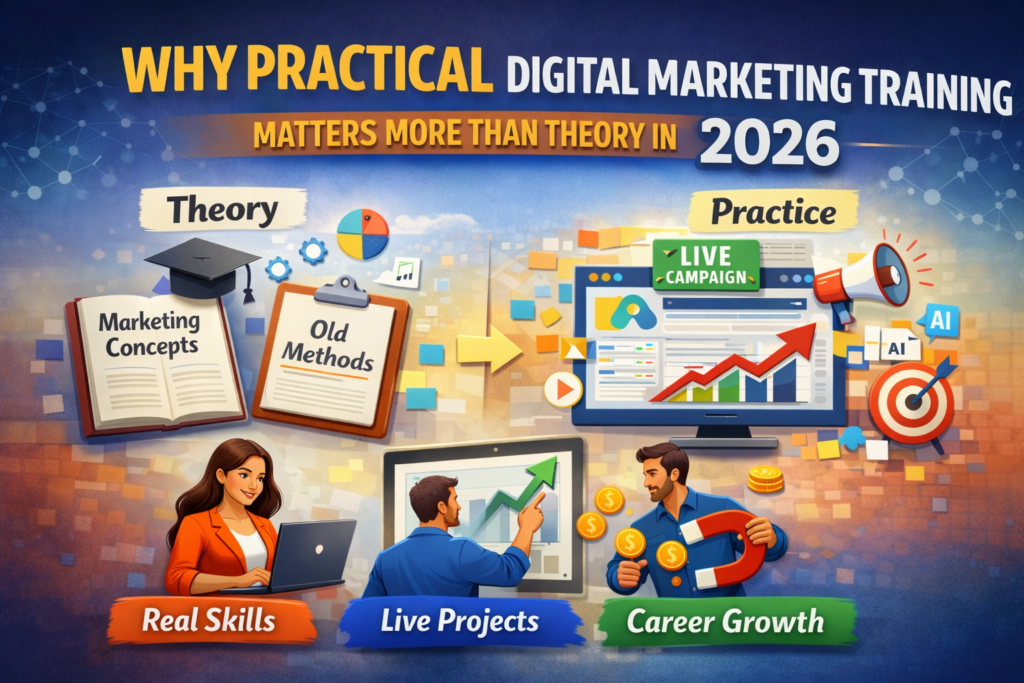
This is Why Practical Digital Marketing Training Matters in 2026. While Theory gives a foundation, real growth, confidence, and career success come from hands-on experience. In this blog, we will explain step by step why practical training has become essential, how it impacts careers, and what students, job seekers, and business owners should look for in a modern digital marketing course.
Understanding the Reality of Digital Marketing in 2026
In 2026, Digital Marketing is fast-paced, AI-driven, and highly competitive. Success depends on practical skills, data analysis, creativity, and adaptability to changing algorithms. Marketers must deliver measurable results, not just ideas. Continuous learning and hands-on experience are essential to survive and grow in the digital Marketing
In 2026, Digital Marketing is driven by:
- AI-Powered tools (ChatGPT, Gemini, Automation Platforms)
- Data and Analytics-based decision making
- Performance Marketing (ROI-focused campaigns)
- Continuous Algorithm Updates
This fast-changing environments cannot be mastered through theory alone. Reading about SEO or Google Ads is very different from actually:
- Running live ad campaigns
- Optimizing keywords based on real data
- Fixing ad disapprovals
- Improving Conversion rates
Practical exposure prepares you for real-world challenges that theory never covers.
The Limitations of Theory-Based Digital Marketing Learning
Theory-based learning has several drawbacks in 2026:
- Outdated Information
Digital Marketing strategies changes every few months. Books and PDFs become outdated quickly, while practical training adapts in real time.
- No Confidence Building
Knowing definitions does not give confidence. Confidence comes from executing campaigns, handling budgets, and solving real problems.
- Zero Industry Readiness
Companies don’t want to train beginners from scratch. They expect candidates to understand tools, dashboards, and workflows.
- No Portfolio Creation
Theory alone cannot help you build:
- Campaign Reports
- Ad Creatives
- SEO Audit Files
- Analytics Dashboards
Without a portfolio, cracking interviews becomes difficult.
Why Practical Digital Marketing Training Is a Game-Changer
Practical Training Focuses on learning by doing. It transforms learners into skilled professionals.
Hands-On Experience
Practical Training allows students to:
- Work on live websites
- Run Google and Meta ads
- Perform SEO audits
- Create content calendars
- Analyze real campaign data
This experience prepares you for real job roles.
Real-World Problem Solving
In real campaigns, problem always arise:
- Ads get rejected
- Traffic doesn’t convert
- Ranking drop suddenly
- Budgets get exhausted
Practical Training Teaches you how to troubleshoot and optimize.
Role of AI and Tools in Practical Learning(2026 Perspective)
AI is reshaping Digital Marketing. Practical Training ensures you learn how to use AI effectively, not just hear about it.
AI Tools You Must Practice With
- AI content writing tools
- AI ad copy generators
- Automation tools for email and WhatsApp
- AI Analytics and reporting tools
Learning these tools practically saves time, improves productivity, and increases employability.
Practical Training Improves Job & Freelancing Opportunities
Practical digital marketing training improves job and freelancing opportunities by providing real project experience, hands-on AI tools knowledge, and client-handling skills. It helps learners build strong portfolios, crack interviews faster, deliver measurable results, and earn consistently in today’s competitive digital marketing industry.
For Job Seekers
Recruiters prefer candidates who:
- Have worked on live projects
- Understand KPIs and metrics
- Can manage tools independently
Practical training bridges the gap between learning and earning.
For Freelancers
Clients don’t pay for theory. They pay for results. Practical Training helps freelancers:
- Handle client projects confidently
- Deliver measurable outcomes
- Retain long-term clients
Business Owners Benefit More from practical Knowledge
Business owners benefit more from practical digital marketing knowledge because it helps them generate quality leads, optimize ad budgets, understand real-time data, and adapt to AI-driven trends — resulting in faster, smarter, and more sustainable business growth in 2026.
Business owners who learn digital Marketing practically can:
- Reduce dependency on agencies
- Monitor campaign performance
- Make data-backed decisions
- Save marketing costs
Understanding dashboards and reports practically helps avoid marketing scams and wrong investments.
Practical Training Builds a Strong Digital Marketing Portfolio
Practical training builds a strong digital marketing portfolio by showcasing real projects, live campaign results, and hands-on experience with SEO, Social Media, Paid ads, and AI tools. A practical portfolio proves skills to employers and clients, increases job and freelancing opportunities, improves credibility, and helps learners stand out in the competitive digital marketing industry in 2026.
A portfolio is proof of your skills. With practical training, you can showcase:
- SEO ranking improvements
- Paid ad ROI reports
- Social Media growth analytics
- Lead generation funnels
This portfolio becomes your biggest asset in 2026.
Industry Expectation vs Classroom Theory
In 2026, industry expectation focus on practical skills, performance, and real results, while classroom theory mainly explains concepts without execution. Companies expect professionals who can handle tools, run campaigns, analyze data, and solve problem independently. Theory build understanding, but practical experience builds employability and confidence.
| Industry Expectation | Theory-Based Learning | Practical Training |
|---|---|---|
| Tool Knowledge | Limited | Advanced |
| Live Campaign handling | No | Yes |
| Problem-solving | Low | High |
| Job readiness | Weak | Strong |
The difference is clear — Practical Trainings aligns with industry needs.
How Practical Training Enhances Decision-Making Skills
Practical training enhances decision-making skills by allowing learners to work on real digital marketing campaigns, analyze live data, and make strategy-based choices. Instead of theoretical learning, practical exposure helps understand audience behavior, budget allocation, ad performance, and conversion optimization. By testing, tracking, and improving campaigns in real time, learners develop analytical thinking and problem-solving skills. This hands-on approach builds confidence, reduces costly mistakes, and enables faster, smarter decision-making in a competitive, AI-powered marketing landscape.
Digital marketing Success depends on decisions:
- Which keywords to target
- Which ad creatives perform better
- When to scale or stop campaigns
Practical Exposure trains your mind to read data, analyze trends, and act strategically.
Certifications vs Skills – What Matters in 2026
In 2026, the digital marketing and tech industry has clearly shifted its focus from certifications to real, practical skills. Certifications are still useful because they show that you have completed a course and understand the basic concepts. They help in building initial credibility, specially for beginners or freshers. However, certifications alone are no longer enough to secure a job or grow career.
Employers today want professional who can execute tasks, solve real problems, and deliver measurable results. Skills such as running ad campaigns, optimizing SEO, analyzing data, using AI tools, and managing real projects matter far more than just holding certificates. With AI now able to explain theory easily, human value lies in practical application, creativity, and decision-making. In 2026, Certifications may open doors, but skills keep you employed and help you grow.
Certificate alone are not enough. Employers now ask:
- Can you run campaigns?
- Can you generate leads?
- Can you improve conversions?
Practical skills outweigh certificates, and training, focused on execution delivers long-term value.
Choosing the Right Practical Digital Marketing Course
Choosing the right practical digital marketing course is very important in 2026 the industry demands real skills, not just certificates. Before enrolling, always check whether the course includes live projects, where you can work on real campaigns and understand how digital marketing words in real scenarios. A good course should also offer internship opportunities or hands-on-assignments to build confidence and practical exposure.
Make sure the syllabus is tools-based, covering platforms like Google Ads, Meta Ads, SEO tools, analytics, and automation software. An AI-Integrated syllabus is essential in 2026, as AI plays a major role in marketing strategies. Additionally, look for placement support, career guidance, and portfolio creation, which help you stands out in interviews. Avoid course that focus only on slides and theory, as they do not prepare you for real-world challenges.
Before enrolling, check if the course offers:
- Live Projects
- Internship or hands-on assignments
- Tools-based learning
- AI-Integrated Syllabus
- Placement or career guidance
- Portfolio creation support
Avoid course that focus only on slides and theory.
Future of Digital Marketing Learning
The future of digital marketing learning is hands-on, AI-driven, and skill-focused. Practical training with real projects, analytics, and automation tools will dominate, enabling learners to stay ahead of trends, adapt to evolving platforms, and secure better jobs or freelancing opportunities in a competitive 2026 digital marketing landscape.
By 2026 and beyond:
- Learning will be skill-based
- A-assisted execution will dominate
- Practical expertise will decide growth
Those who practice regularly will stay ahead of the competition.
Conclusion
In 2026, Practical Digital Marketing Training Matters More Than Theory because the industry demands execution, adaptability, and measurable results. Theory can introduce concepts, but only practical learning builds confidence, skills, and career success.
Whether you are a student, Job seeker, freelancer, or business owner, investing in practical digital marketing training is no longer optional— It is essential. The future belongs to those who learn by doing, experiment with tools, analyze data, and continuously upgrade their skills. If your goal is real income, and real impact, choose practical Digital Marketing training over theory— and stay future-ready in 2026 and beyond. And if are give the more information so visit the OnePlaceDigital Academy